0 of 115. That is how many of the sites we checked used robots.txt to block an AI search crawler. We looked at 122 company websites, mostly software brands. 115 answered, and none of them blocked, in robots.txt, the crawlers that decide whether a site can appear in an AI answer.
The risk was real, but it was somewhere else. Seven of the 106 homepages we could read returned under 150 words of text to a plain request. Our earlier post on which AI crawler does what explains which crawler does what. This one is about what we found when we looked.
What we checked
The 122 sites are company websites, mostly software brands and their competitors, mostly large and well known. For each, we made about four plain requests with a user agent that says who we are: robots.txt, the homepage, llms.txt and the sitemap.
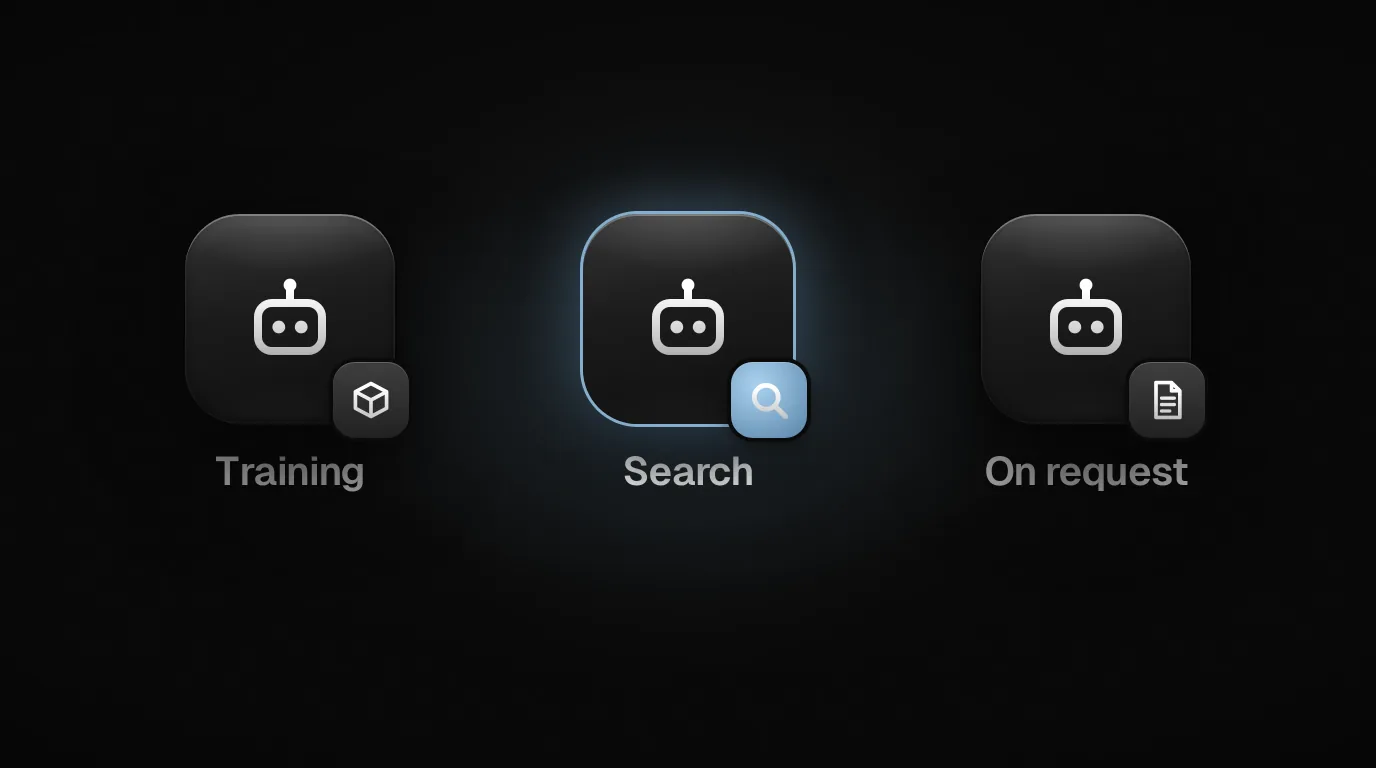
We read robots.txt as the Robots Exclusion Protocol (RFC 9309) defines it. We then checked five crawlers behind AI answers: OAI-SearchBot (ChatGPT search), PerplexityBot, Claude-SearchBot, Googlebot (Google AI Overviews) and Bingbot (Copilot).
We also recorded training crawlers such as GPTBot, ClaudeBot and Google-Extended. We did not count them as a problem. Blocking a training crawler is a business choice.
What we found
| Check | Result |
|---|---|
| robots.txt blocks an AI search crawler (sites that answered) | 0 of 115 |
| robots.txt blocks a training crawler | 8 to 12 sites, depending on the crawler |
| Homepage returns under 150 words of text to a plain request | 7 of 106 |
| llms.txt present | 55 of 122 (45%) |
| Sitemap found | 99 of 122 (81%) |
| JSON-LD structured data on the homepage | 77 of 106 (73%) |
| Bot challenge on a plain request | 7 (inconclusive) |
| Unreachable on the bare domain | 7 |
Blocking a search crawler was rare. It matters because OpenAI says a site that opts out of OAI-SearchBot will not be shown in ChatGPT search answers, though it can still appear as navigational links (OpenAI). None of our 115 sites did it.
A few homepages returned almost no text. From outside we cannot tell which of the seven need JavaScript to show their text and which sit behind a bot or region wall. In December 2024, Vercel and MERJ reported that the AI companies' own crawlers they tested did not run JavaScript, while Googlebot (which serves Gemini) and AppleBot did. That was a 2024 measurement, so check each vendor's current documentation. If your product page is drawn by a script, an AI crawler may see a blank page.
llms.txt is common but unproven. Nearly half the sites had one. In June 2026, Google's John Mueller said that none of the AI systems use it, as reported by Search Engine Journal. We treat it as optional.
What an outside check cannot see
Seven sites would not load on the bare domain. The causes were two addresses that did not respond at all, a broken certificate, a 503 error, a timeout, a connection reset, and one site that only worked with www. in front. "We could not reach it" is not the same as "it blocks AI".
Seven more answered with a bot challenge. A firewall can let a verified crawler through while challenging an unknown one like ours, and we cannot test that from outside. The honest result is "could not verify", not "blocked".
Why your site may differ
Our sites are mostly large, established software brands. The disaster case is rare there and likely less rare for small sites. On 1 July 2025, Cloudflare announced that it would block AI crawlers by default and ask every new domain at sign-up whether to allow them. A small site on a host with that kind of default could be shut out without anyone choosing it. We did not test this.
Does llms.txt work?
Nothing we found shows that llms.txt makes AI engines cite a site, and Google says its Search ignores the file.
- What our check saw. 55 of the 122 sites (45%) had an llms.txt file. That counts files. It does not show that any AI engine read one, that those sites were cited more often, or that they ranked better, and this check did not look at any of those. It is a snapshot of 122 sites.
- What Google says. Google's guide says you do not need "new machine readable files, AI text files, markup, or Markdown to appear in Google Search (including its generative AI capabilities), as Google Search itself doesn't use them". It adds that creating llms.txt files for other services that use them "will neither harm nor help your site's visibility or rankings in Google Search, as Google Search ignores them" (Google Search Central, page updated 10 July 2026, checked 26 November 2026).
- What the AI companies say. The crawler pages we read on 26 November 2026 from OpenAI, Anthropic and Perplexity describe robots.txt rules for their crawlers. None of the three pages mentions llms.txt. That does not show that nothing reads the file, only that these companies' crawler pages do not say so.
Verdict: treat llms.txt as optional. The ten-minute check below is about whether crawlers can reach and read your pages, and the table of AI crawlers says what each crawler does.
A ten-minute check for your site
- Open yourdomain.com/robots.txt. Look for a Disallow rule under OAI-SearchBot, PerplexityBot, Claude-SearchBot, Googlebot or Bingbot, or a blanket rule for every crawler.
- View your key pages with JavaScript turned off. If the text is missing, assume AI crawlers cannot read it.
- Check your CDN or firewall settings for an AI-bot toggle.
- Decide on training crawlers as a business choice. Keep that decision separate from search.
- Do not spend long on llms.txt.
To allow the search crawlers explicitly:
User-agent: OAI-SearchBot
Allow: /

User-agent: PerplexityBot
Allow: /

User-agent: Claude-SearchBot
Allow: /
To opt out of training only:
User-agent: GPTBot
Disallow: /

User-agent: ClaudeBot
Disallow: /

User-agent: Google-Extended
Disallow: /
Google-Extended is a control, not a crawler, and it limits more than training: Google says it also covers grounding in its AI products outside Search, such as Gemini. See AI crawlers and what they do.
ChatGPT-User and Perplexity-User fetch a page when a person asks about it. Their documentation says robots.txt rules may not apply to them.
Whether answers then cite your pages is a separate question, counted in a separate study: How often do AI answers cite a brand's own website?
Citestreak's Website readiness check runs this kind of test on your site and up to eight competitors. See Actions.