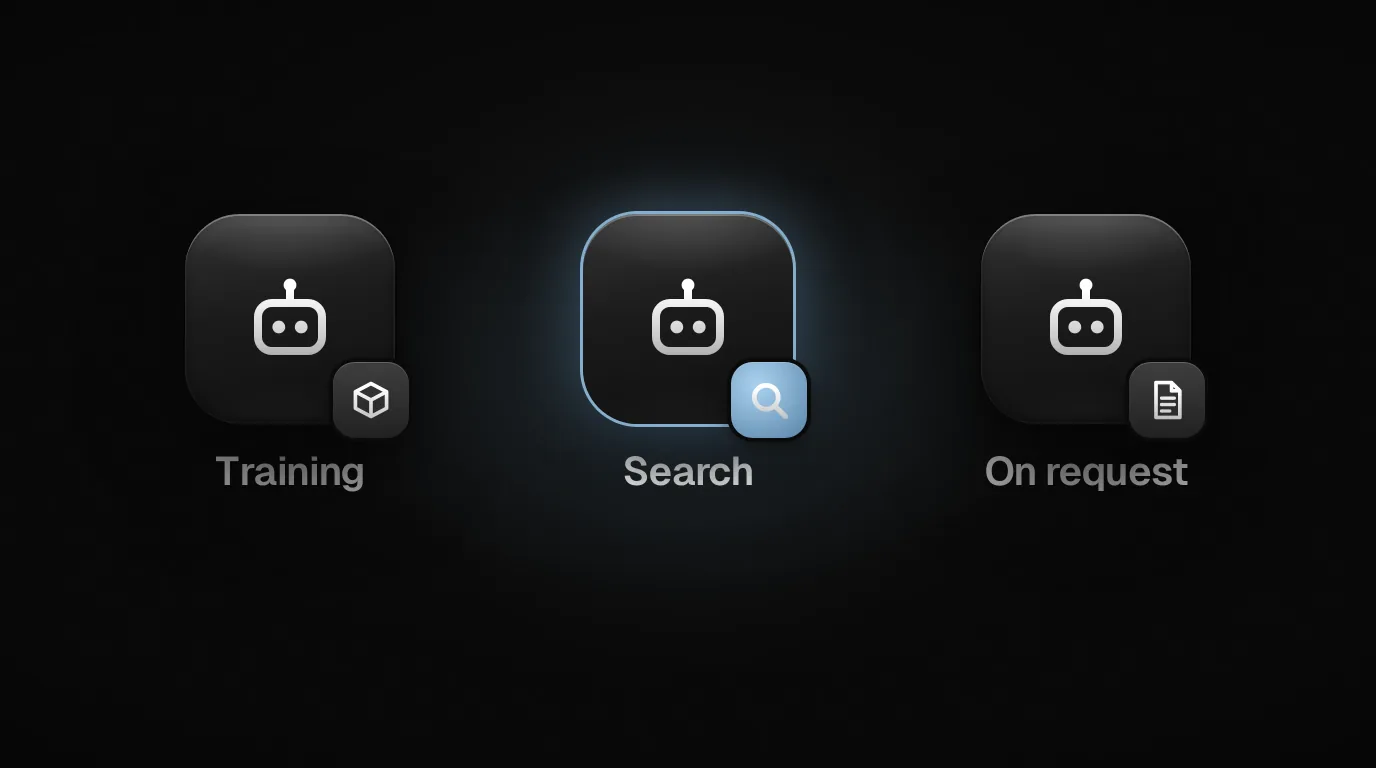
AI companies do not run one crawler each. They run several, for different jobs. OpenAI's documentation lists four. Treating them as one category in your robots.txt is how a site ends up blocking the wrong one.
They do not all do the same job
OpenAI's crawler documentation (checked 25 November 2026) lists four agents:
- GPTBot crawls content that may be used to train OpenAI's models. Disallowing it tells OpenAI not to use your content for training.
- OAI-SearchBot surfaces websites in ChatGPT's search features. A site that opts out will not be shown in ChatGPT search answers, though it can still appear as navigational links.
- ChatGPT-User acts when a person asks ChatGPT to visit a page. OpenAI says robots.txt rules may not apply to it.
- OAI-AdsBot checks the safety of pages submitted as ads on ChatGPT.
The same split exists at other companies.
- Anthropic's documentation names three: ClaudeBot collects content that could contribute to training, Claude-User supports people asking Claude questions, and Claude-SearchBot improves search result quality.
- Perplexity's documentation names two: PerplexityBot surfaces sites in Perplexity's search results and is not used for training, and Perplexity-User supports user actions and generally ignores robots.txt.
- Google-Extended is not a crawler with its own user agent. It is a robots.txt token that controls whether content Google crawls can be used for Gemini training and grounding. Google says it does not affect inclusion in Google Search and is not a ranking signal (Google).
Why blanket blocking backfires
The instinct to "block the AI bots" usually targets training crawlers. But the agent that lets an engine show you in its answers is a different one. If you disallow OAI-SearchBot, you will not be shown in ChatGPT search answers. Disallow the wrong line and you can keep the training crawler out while also removing yourself from the answers your buyers see.
A sane policy
Decide separately on two questions. Do you want your content used for training? Do you want to be retrievable in answers? They have different user agents and different consequences. If you want to be found, allow the search crawlers unless you have a specific reason not to. Treat training as a separate business decision.
We checked 122 sites we track. None of the 115 that answered blocked an AI search crawler, and 8 to 12 blocked a training crawler. See what we found.
Then re-check. Vendors add and rename agents, so a policy you set a year ago may be out of date. Re-read each vendor's documentation and your robots.txt now and then.
AI crawlers and what they do
What each company's own page says, checked 26 November 2026. The first column uses the names, user-agent tokens or robots.txt control tokens shown in the linked documentation. Companies add and rename agents, so read the linked page before you change a rule.
| Crawler (company) | What the company says it is for | What the company says about controlling it |
|---|---|---|
| GPTBot (OpenAI) | Crawls content that may be used to train OpenAI's generative AI foundation models. | Disallowing it indicates a site's content should not be used for that training. OpenAI says you can set GPTBot and OAI-SearchBot independently. |
| OAI-SearchBot (OpenAI) | Surfaces websites in search results in ChatGPT's search features. | A site that opts out is not shown in ChatGPT search answers, though it can still appear as navigational links. OpenAI recommends allowing it in robots.txt and allowing requests from its published IP ranges, and says its systems can take about 24 hours to adjust after a robots.txt update. |
| ChatGPT-User (OpenAI) | May visit a page when a person asks ChatGPT or a custom GPT a question. Not used to crawl the web automatically. | Because a person starts the request, robots.txt rules may not apply. It is not used to decide whether content appears in search; OpenAI points to OAI-SearchBot for that. |
| OAI-AdsBot (OpenAI) | Checks the safety of pages submitted as ads on ChatGPT. It visits only pages submitted as ads, and OpenAI says its data is not used to train generative AI foundation models. | OpenAI's page gives no robots.txt instructions for it. |
| ClaudeBot (Anthropic) | Collects web content that could contribute to training Anthropic's generative AI models. | Restricting it signals that the site's future material should be excluded from training datasets. Anthropic says a robots.txt rule that names ClaudeBot takes priority over the general no-training signal it began recognizing on 30 October 2026. |
| Claude-SearchBot (Anthropic) | Navigates the web to improve search result quality for users. | Disabling it prevents Anthropic from indexing the content for search optimization, which may reduce the site's visibility and accuracy in user search results. |
| Claude-User (Anthropic) | May visit a page when a person asks Claude a question. | Anthropic says its bots honor robots.txt. Disabling Claude-User prevents Anthropic from retrieving the content in response to a user's question, which may reduce the site's visibility for user-directed web search. |
| PerplexityBot (Perplexity) | Designed to surface and link websites in Perplexity's search results. Not used to crawl content for AI foundation models. | Perplexity recommends allowing it, and allowing requests from its published IP ranges. |
| Perplexity-User (Perplexity) | Supports user actions: when a person asks a question it may visit a page and link to it in the answer. Perplexity says it is not used for web crawling or to collect content for training AI foundation models. | Because a person requested the fetch, it generally ignores robots.txt rules. |
| Googlebot (Google) | Google's crawler for Search. | Google says crawling preferences for Googlebot affect Google Search, including all its features. It also says AI is built into Search, so robots.txt rules for Googlebot are the control for how a site is crawled for Search, AI features included (AI features page). |
| Google-Extended (Google) | A control token, not a crawler: it has no user agent string of its own. It lets you limit how Google uses crawled content to train future foundation models for certain commercial generative AI products and to ground responses in those products outside Search. | To limit that use, disallow it in robots.txt. Google says it does not affect a site's inclusion in Google Search or its ranking. To manage grounding in AI Overviews and AI Mode, Google points to the Search generative AI control in Search Console. |
| Applebot (Apple) | Its data powers search in Spotlight, Siri and Safari. Apple says the data may also help train its models and add context to AI answers. | In general search crawls it follows robots.txt rules addressed to Applebot. If the file names Googlebot but not Applebot, it follows Googlebot's rules. To keep content out of Apple's AI answers to broad questions, Apple points to the nosnippet meta tag, which also stops Applebot generating a description for the page. |
| Applebot-Extended (Apple) | Does not crawl. It decides how data crawled by Applebot may be used. | To opt out of training Apple's general-purpose generative AI models, disallow it. Pages that disallow it can still appear in search. |
| Bingbot (Microsoft) | Bing's standard crawler, which handles most of Bing's crawling. | Robots.txt tells Bing's crawlers how to treat a site. On 30 October 2026 Microsoft announced separate AI training and AI grounding preferences. It says it will start honoring them as it crawls from 1 February 2027, that training can be set in robots.txt or on a page, and that grounding can be set only on a page. Sites that use NoArchive or NoCache should read Microsoft's transition steps. |
| CCBot (Common Crawl) | Collects pages for Common Crawl's open repository of web crawl data, which anyone can use. | To stop Common Crawl crawling your site, disallow CCBot in robots.txt. |
| meta-externalagent (Meta) | Crawls the web for uses such as training foundation AI models or improving products by indexing content directly. | To block it, add a disallow for it in robots.txt. |
| meta-webindexer (Meta) | Navigates the web to improve Meta AI search result quality. | Meta says allowing it helps Meta cite and link to your content in Meta AI's responses. |
| meta-externalfetcher (Meta) | Fetches individual links at a user's request, supporting functions such as evaluating and improving agentic AI capabilities. | Meta says it may bypass robots.txt rules. |
GPTBot (OpenAI)
- What the company says it is for
- Crawls content that may be used to train OpenAI's generative AI foundation models.
- What the company says about controlling it
- Disallowing it indicates a site's content should not be used for that training. OpenAI says you can set GPTBot and OAI-SearchBot independently.
OAI-SearchBot (OpenAI)
- What the company says it is for
- Surfaces websites in search results in ChatGPT's search features.
- What the company says about controlling it
- A site that opts out is not shown in ChatGPT search answers, though it can still appear as navigational links. OpenAI recommends allowing it in robots.txt and allowing requests from its published IP ranges, and says its systems can take about 24 hours to adjust after a robots.txt update.
ChatGPT-User (OpenAI)
- What the company says it is for
- May visit a page when a person asks ChatGPT or a custom GPT a question. Not used to crawl the web automatically.
- What the company says about controlling it
- Because a person starts the request, robots.txt rules may not apply. It is not used to decide whether content appears in search; OpenAI points to OAI-SearchBot for that.
OAI-AdsBot (OpenAI)
- What the company says it is for
- Checks the safety of pages submitted as ads on ChatGPT. It visits only pages submitted as ads, and OpenAI says its data is not used to train generative AI foundation models.
- What the company says about controlling it
- OpenAI's page gives no robots.txt instructions for it.
ClaudeBot (Anthropic)
- What the company says it is for
- Collects web content that could contribute to training Anthropic's generative AI models.
- What the company says about controlling it
- Restricting it signals that the site's future material should be excluded from training datasets. Anthropic says a robots.txt rule that names ClaudeBot takes priority over the general no-training signal it began recognizing on 30 October 2026.
Claude-SearchBot (Anthropic)
- What the company says it is for
- Navigates the web to improve search result quality for users.
- What the company says about controlling it
- Disabling it prevents Anthropic from indexing the content for search optimization, which may reduce the site's visibility and accuracy in user search results.
Claude-User (Anthropic)
- What the company says it is for
- May visit a page when a person asks Claude a question.
- What the company says about controlling it
- Anthropic says its bots honor robots.txt. Disabling Claude-User prevents Anthropic from retrieving the content in response to a user's question, which may reduce the site's visibility for user-directed web search.
PerplexityBot (Perplexity)
- What the company says it is for
- Designed to surface and link websites in Perplexity's search results. Not used to crawl content for AI foundation models.
- What the company says about controlling it
- Perplexity recommends allowing it, and allowing requests from its published IP ranges.
Perplexity-User (Perplexity)
- What the company says it is for
- Supports user actions: when a person asks a question it may visit a page and link to it in the answer. Perplexity says it is not used for web crawling or to collect content for training AI foundation models.
- What the company says about controlling it
- Because a person requested the fetch, it generally ignores robots.txt rules.
Googlebot (Google)
- What the company says it is for
- Google's crawler for Search.
- What the company says about controlling it
- Google says crawling preferences for Googlebot affect Google Search, including all its features. It also says AI is built into Search, so robots.txt rules for Googlebot are the control for how a site is crawled for Search, AI features included (AI features page).
Google-Extended (Google)
- What the company says it is for
- A control token, not a crawler: it has no user agent string of its own. It lets you limit how Google uses crawled content to train future foundation models for certain commercial generative AI products and to ground responses in those products outside Search.
- What the company says about controlling it
- To limit that use, disallow it in robots.txt. Google says it does not affect a site's inclusion in Google Search or its ranking. To manage grounding in AI Overviews and AI Mode, Google points to the Search generative AI control in Search Console.
Applebot (Apple)
- What the company says it is for
- Its data powers search in Spotlight, Siri and Safari. Apple says the data may also help train its models and add context to AI answers.
- What the company says about controlling it
- In general search crawls it follows robots.txt rules addressed to Applebot. If the file names Googlebot but not Applebot, it follows Googlebot's rules. To keep content out of Apple's AI answers to broad questions, Apple points to the
nosnippetmeta tag, which also stops Applebot generating a description for the page.
Applebot-Extended (Apple)
- What the company says it is for
- Does not crawl. It decides how data crawled by Applebot may be used.
- What the company says about controlling it
- To opt out of training Apple's general-purpose generative AI models, disallow it. Pages that disallow it can still appear in search.
Bingbot (Microsoft)
- What the company says it is for
- Bing's standard crawler, which handles most of Bing's crawling.
- What the company says about controlling it
- Robots.txt tells Bing's crawlers how to treat a site. On 30 October 2026 Microsoft announced separate AI training and AI grounding preferences. It says it will start honoring them as it crawls from 1 February 2027, that training can be set in robots.txt or on a page, and that grounding can be set only on a page. Sites that use NoArchive or NoCache should read Microsoft's transition steps.
CCBot (Common Crawl)
- What the company says it is for
- Collects pages for Common Crawl's open repository of web crawl data, which anyone can use.
- What the company says about controlling it
- To stop Common Crawl crawling your site, disallow CCBot in robots.txt.
meta-externalagent (Meta)
- What the company says it is for
- Crawls the web for uses such as training foundation AI models or improving products by indexing content directly.
- What the company says about controlling it
- To block it, add a disallow for it in robots.txt.
meta-webindexer (Meta)
- What the company says it is for
- Navigates the web to improve Meta AI search result quality.
- What the company says about controlling it
- Meta says allowing it helps Meta cite and link to your content in Meta AI's responses.
meta-externalfetcher (Meta)
- What the company says it is for
- Fetches individual links at a user's request, supporting functions such as evaluating and improving agentic AI capabilities.
- What the company says about controlling it
- Meta says it may bypass robots.txt rules.
The table is not a full list. Meta also lists crawlers for shared links and advertising. Anthropic says its hosted browsers for user-directed tasks send a Claude-Agent token, and that site owners can manage that traffic separately from its crawlers and fetchers (Anthropic, checked 26 November 2026).
Which AI crawlers should you allow?
Decide by purpose. Keep the search crawlers allowed for the engines you want to appear in, check user-requested fetches on their own, and make the training decision separately.
- Search. OAI-SearchBot, Claude-SearchBot, PerplexityBot, Applebot, meta-webindexer, Googlebot and Bingbot find pages for a search service. OpenAI says a site that opts out of OAI-SearchBot will not be shown in ChatGPT search answers, and Anthropic says disabling Claude-SearchBot may reduce a site's visibility and accuracy in search results. If you want to appear in an engine's answers, allow its search crawler.
- User fetch. ChatGPT-User, Claude-User, Perplexity-User and meta-externalfetcher may fetch a page at a person's request. OpenAI says robots.txt rules may not apply to ChatGPT-User, Perplexity says Perplexity-User generally ignores them, and Meta says meta-externalfetcher may bypass them, so a rule may not stop these. Anthropic says Claude-User follows robots.txt, and that disabling it may reduce a site's visibility for user-directed web search.
- Training. GPTBot, ClaudeBot, Google-Extended, Applebot-Extended and meta-externalagent are described by their companies as used for AI training (Google-Extended also for grounding outside Search, and Meta adds indexing content). CCBot collects pages for an open dataset that anyone can use. OpenAI, Google and Apple each say this setting is separate from search: you can allow OAI-SearchBot and disallow GPTBot, Google-Extended does not affect inclusion in Google Search, and pages that disallow Applebot-Extended can still appear in Apple's search. Whether to allow training is a business decision.
For the other file people ask about, see Does llms.txt work?
Citestreak's Website readiness check tests whether the search crawlers behind AI answers are allowed on your site and on up to eight competitors' sites. It identifies itself as CitestreakBot. See Actions.