95% against 7%. Searchable, an AI-visibility vendor, compared 3,989 brands over the 30 days to 15 October 2026. The median brand was named in 95% of the AI answers to prompts that named it, and in only 7% of the answers to prompts that did not.
Prompts that name your brand make a mention far more likely. Report branded and unbranded visibility separately, so you can see how often AI brings you up on its own. A score that blends the two tells you less than you think.
Should you combine branded and unbranded visibility?
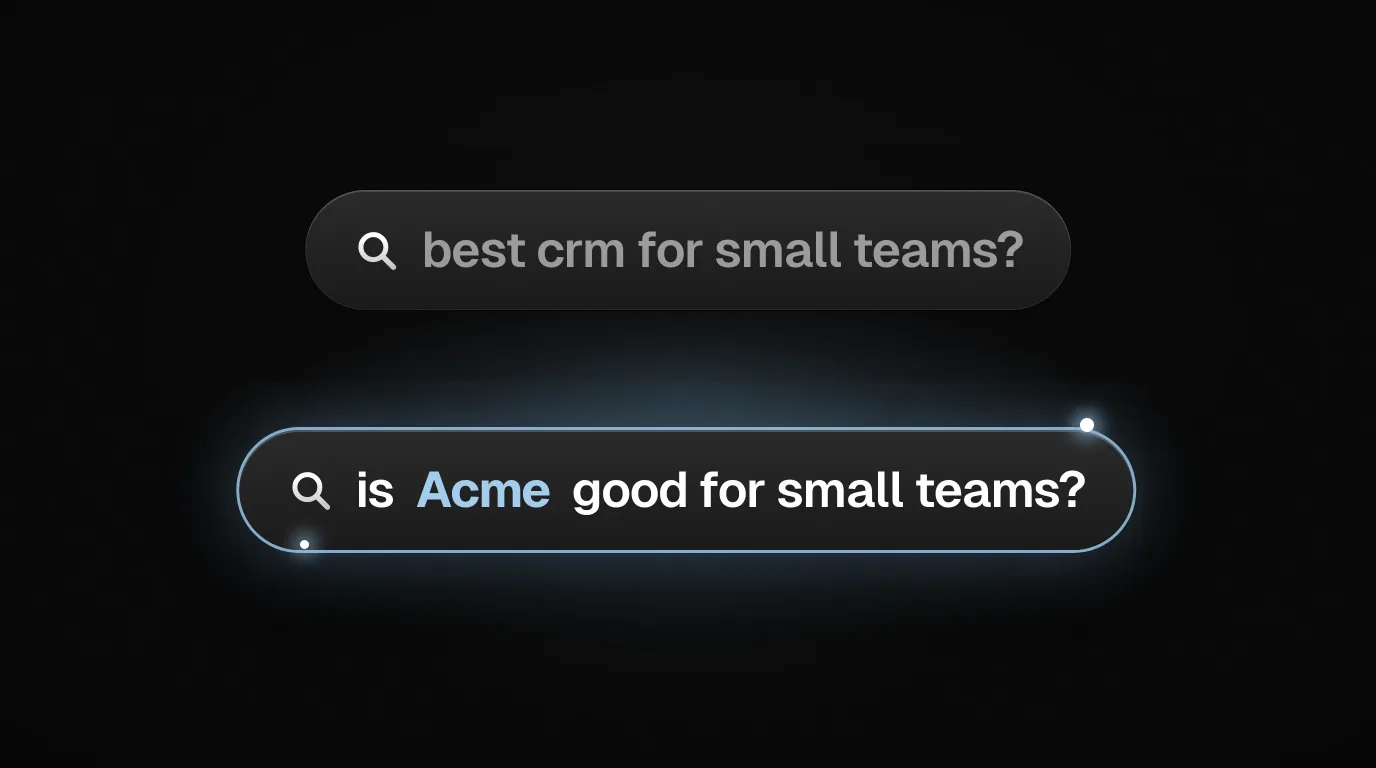
Ask an AI "Is Acme good?" and the answer will almost always name Acme. That tells you the AI can talk about Acme when asked. It does not tell you the AI will bring Acme up when a buyer asks "what is the best tool for X?"
Here is an invented example. Acme tracks 10 prompts. Four of them name Acme, such as "Is Acme worth it?". Six do not, such as "best tool for X". The AI names Acme in all four branded answers and in one of the six unbranded answers.
| Prompts | Answers naming Acme | Visibility | |
|---|---|---|---|
| Branded | 4 | 4 | 100% |
| Unbranded | 6 | 1 | 17% |
| Blended | 10 | 5 | 50% |
The blended 50% looks respectable. It hides that Acme appeared in only one of the six unbranded answers. It also moves when you change the mix, not the AI. Add two more branded prompts and the blend rises to 7 of 12, or 58%, though nothing about the AI changed.
What counts as branded
A prompt is branded when it names your own brand: its name, another name you use, or one of your domains. A prompt that names only a competitor, such as "alternatives to Northwind", is unbranded. It does not hand the AI your name, so it tests whether you come up in a competitor-led question.
What buyers type
Buyers who have not heard of you cannot type your name. A prompt list written by people who know your brand may lean towards it.
In a January 2026 survey of 524 active LLM users by the agency Stella Rising, 13% of the prompts people wrote mentioned a specific brand. Respondents wrote the prompt they would type for a shopping task (buying a pair of shoes), so this is what people say they would ask, not logged behaviour.
The survey measured how often people named any brand in that task, so a list in which most prompts name you is unlikely to match how buyers ask. The size of the gap in your own data is not a forecast. The mechanism is the point: a prompt that names you usually gets you named.
How to build a set that does not flatter you
- Report the two groups separately. Read branded answers to see how AI describes you when asked by name. Unbranded visibility tells you whether buyers find you. One real day's split between questions that name a brand and questions that do not is in Named in almost every answer, yet a third of the conversation.
- Don't show a blend on its own. A blend moves when you change the mix of prompts, even if nothing about the AI changed. If you show one, show both rates beside it and say the mix.
- Keep branded prompts to a quarter of the set or less. Conductor, another vendor, gives the same guidance (about 75% unbranded and 25% branded) and warns that branded prompts often paint an overly positive picture.
- Say what share of your set is branded every time you show a number.
The edge case: brand names that are common words
Imagine a brand called Bridge. The prompt "how do we bridge the gap between sales and marketing?" contains the word but not the brand. Now flip it. A buyer types "bridge pricing" in lower case and means your product.
Any automatic label can get this wrong, in either direction. Checking for capital letters, for example, would miss the lower-case buyer. So check the labels on your own list by hand, and fix the ones that are wrong. In Citestreak you can override any prompt's label.
A ten-minute audit of your own prompt list
- Mark every prompt that contains your name, another name you use, or your domain.
- Count them. If they are over a quarter of the list, your score is probably flattering you.
- Work out visibility for each group on its own.
- Replace some branded prompts with category questions a buyer would ask before they know you.
In Citestreak, each prompt carries a Branded or Unbranded label that you can override. The filter bar has a Prompts control with All, Branded and Unbranded, so you can look at each group on its own. The Prompts page warns you when more than 25% of your active prompts are branded, and the Snapshot report has a Branded vs unbranded section.
See how the split works in Prompts.