An AI answer can draw on what the model learned in training, details you give it, and information it finds through web search. Which of these an answer used is not always visible. A citation gives you a page to check, and an answer without citations may still have used web search.
What information can an AI answer use?
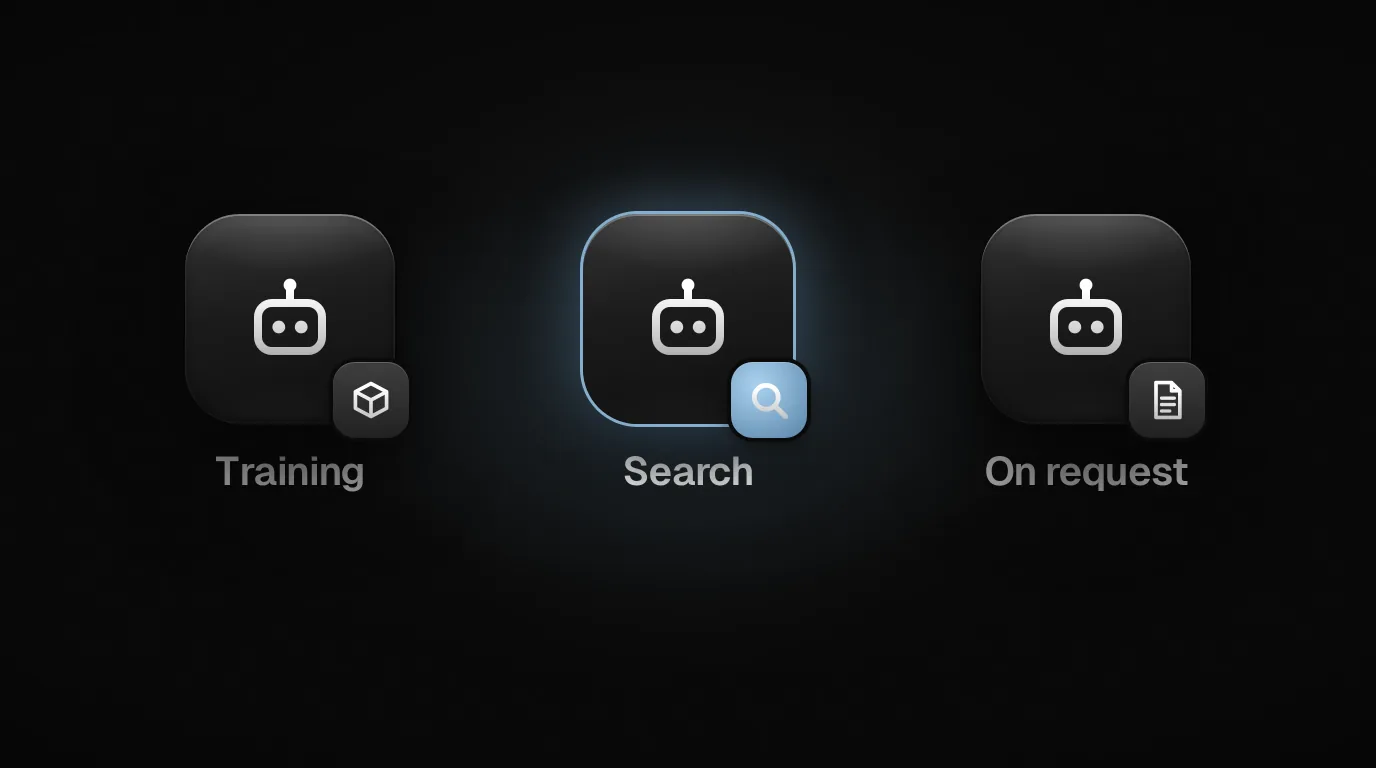
It can use what it learned in training, what you tell it, and what it finds through search.
| Source | In plain words | What you can check |
|---|---|---|
| Training | Patterns the model learned from a very large body of text before you asked | A claim can appear without an original page you can check |
| Your message | Details you put in your question | The details in your own message |
| Web search | Information the tool finds through web search | The pages it cites, when the tool shows its sources |
OpenAI says its models do not store or retain copies of the data they are trained on (OpenAI, read 26 November 2026). Google says its AI search features retrieve relevant pages from its Search index and can run related searches to find more results (Google Search Central, updated 10 July 2026).
When does an AI tool search the web?
Some tools decide when to search, and some let you request a search. OpenAI says ChatGPT "may search the web automatically when your question would benefit from current information", and on chatgpt.com you can also select Web search. If ChatGPT answered without searching, you can ask it to search in a follow-up message (OpenAI help, read 26 November 2026). Anthropic says Claude invokes a search tool when a topic benefits from current information, and that in the new Claude experience "Claude searches the web when it helps" (Anthropic help, read 26 November 2026). Perplexity says it searches the internet when you ask a question and numbers its citations (Perplexity help, read 26 November 2026).
Tools can make different search decisions for the same question. The absence of citations alone leaves it unclear whether a tool searched. Of 1,006 answers we had collected across engines by 31 July 2026, 69 (6.9%) came back with no sources, and 55 of those still named brands (What does an AI citation actually tell you?).
Does a citation show where the answer got its information?
A citation shows which page the answer points to. Open that page to see whether it supports the specific claim. OpenAI says search results and citations "can be incomplete, outdated, or incorrect", and advises you to open a cited source to check that it supports the answer (OpenAI help, read 26 November 2026). Anthropic says original websites "may contain important context or details not included in Claude's synthesis" (Anthropic help, 16 March 2026).
The link between a claim and a source can also be loose. In the Google AI Overviews we collected by 9 September 2026, only 371 of 747 listed references (49.7%) were tied to a passage in the answer text. That describes what we saw, not a law of Google (What does an AI citation actually tell you?).
How do you open a citation and check it?
- Open the cited page. If the tool shows a separate list of sources, look for links attached to the specific claim.
- Find the evidence for the claim on the page. If you cannot find it, record that you could not verify it there.
- Note who published the page and when it was updated. Is it the brand's own page, a review, a forum thread or a reseller?
- Write down what you asked. Record the tool, the search setting, the date, the exact question, the country, the exact claim and the citation URL, so a colleague can repeat the check.
- Say what the source list shows. If there is only a source list, record which pages support the claim and whether the answer links any of them to it.
- Ask again with a specific source. OpenAI suggests asking ChatGPT to search again using a specific source, date or location (OpenAI help, read 26 November 2026).
Here is an invented example. Acme is a made-up CRM. An answer says: "Acme's free plan includes up to three users." Its sources are acme.example/pricing and a 2024 review on crm-reviews.example. Acme's pricing page says the free plan includes one user. The 2024 review contains the three-user figure. The cited pricing page does not support the claim.
Why can the same question get different answers?
Responses can vary between runs. Search queries, location, and whether an AI Overview appears can also affect what you see.
- Whether Google shows an overview at all. We asked 50 prompts twice each, and in 23 of the 50 pairs the two answers did not match. In 21 of those 23, one ask got a Google AI Overview and the other got nothing (Why Google AI Overviews sometimes show nothing).
- Run to run. OpenAI says there is "an inherent element of randomness" in how a model responds, so the same question "may yield different answers across different queries" (OpenAI, read 26 November 2026). In a study published on 28 January 2026, SparkToro and Gumshoe.ai had 600 volunteers run 12 prompts on ChatGPT, Claude and Google's AI, 2,961 runs in all. In the study's brand-recommendation prompts, the authors estimated less than a 1-in-100 chance that two responses from ChatGPT or Google's AI would give the same brand list. The Google runs used AI Overviews, with AI Mode when an overview did not appear. SparkToro's research partner worked at the AI-tracking startup Gumshoe.ai (SparkToro, 28 January 2026).
- The search behind the answer. ChatGPT may rewrite a question before sending it to a search partner. Its search can use an approximate location, and relevant saved memories can affect the search query when memory is enabled (OpenAI help, read 26 November 2026).
Can a site choose which AI tools may use it?
Partly. OpenAI says its crawler settings are independent of each other: a site can allow OAI-SearchBot to appear in ChatGPT search results while disallowing GPTBot to indicate that its content should not be used in training. OpenAI says sites that block OAI-SearchBot are excluded from ChatGPT search answers, though they can still appear as navigational links (OpenAI crawlers, read 26 November 2026). For all four OpenAI agents, and how other companies split theirs, see AI Crawlers Are Visiting Your Site. To be eligible as a supporting link in Google AI Overviews or AI Mode, a page must be indexed and eligible to appear in Google Search with a snippet. Google does not guarantee that an eligible page will appear (Google Search Central, updated 10 December 2025).
How do you check what AI says about your brand?
Where the tool gives you a search control, try the same brand question with and without web search. Record the setting, the exact claim and any cited URL. Check the claim against the relevant page before you pass it on. The same steps work in the manual check in What is AI visibility? If an answer gets your company wrong, see What to do when AI gets your company wrong.