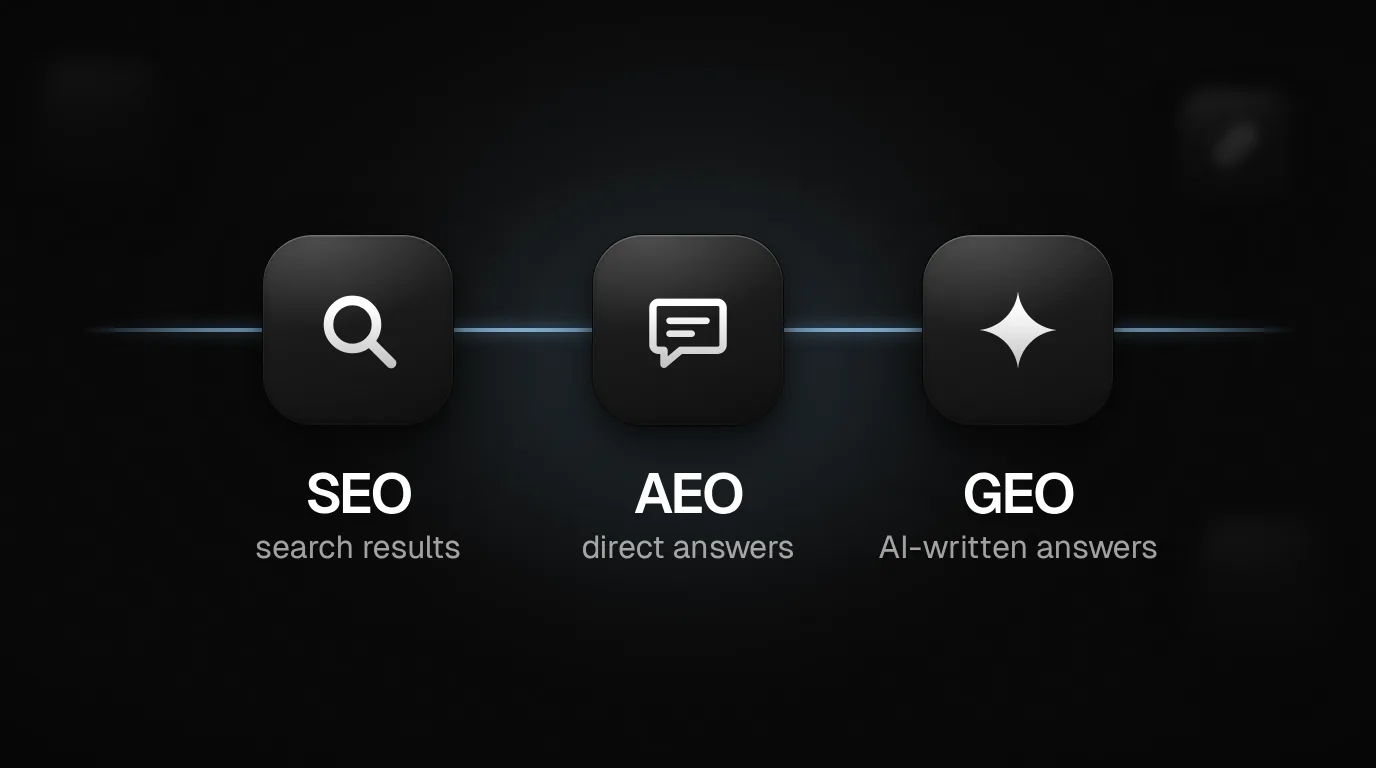
SEO helps pages appear in search results. GEO and AEO are names for work aimed at appearing in AI-generated answers. The names overlap, and Google says that optimizing for generative AI search "is optimizing for the search experience, and thus still SEO" (Google Search Central, updated 10 July 2026).
What do SEO, GEO and AEO stand for?
- SEO is search engine optimization: work to help pages appear in search results and earn visits.
- GEO is generative engine optimization. Aggarwal and colleagues introduced GEO as a framework in a paper first submitted on 16 November 2023 and accepted to the KDD 2024 conference (arXiv, version 3 of 28 June 2024).
- AEO is answer engine optimization. The term describes work aimed at making a brand or its content more visible in direct answers.
Google's guide for site owners names both. It calls them "terms you may see used to describe work specifically focused on improving visibility in AI search experiences" (Google Search Central, updated 10 July 2026).
What is the difference between GEO and SEO?
The goal and what you count.
- SEO aims at visits from search results. You count rankings, clicks and traffic.
- GEO aims at being named or cited in AI answers. You count mentions and citations. See What is AI visibility?
The work overlaps. Google says its AI search features use its core search systems, so its usual SEO advice still applies (Google Search Central, updated 10 July 2026). Two vendors say the same from the other side. Semrush writes that "the strategies that make you visible in search rankings overlap significantly with the ones that get you mentioned in AI answers" (Semrush GEO guide, read 26 November 2026). HubSpot writes that SEO and AEO "are complementary and rely on many of the same tactics" (HubSpot AEO guide, read 26 November 2026).
What is the difference between AEO and GEO?
The same kind of work, under two names. HubSpot uses AEO for visibility and accuracy in AI answers. Semrush uses GEO for visibility in AI-generated responses (both read 26 November 2026). Their definitions overlap, so ask which results a tool measures before you compare labels. For the tools sold under these names, see What do vendors mean by GEO tools and AEO tools? You will also see "LLM SEO" and "AI search optimization". Our glossary lists them.
Is GEO replacing SEO?
No. Google says the best practices for SEO remain relevant to its AI search features (Google Search Central, updated 10 July 2026). What changes is what you track. The Pew Research Center analyzed March 2025 browsing data from 900 US adults and reran their Google searches in April to find which ones returned an AI summary. A regular result link was clicked on 8% of visits for searches classified as having a summary, against 15% for searches without one (Pew Research Center, 22 July 2025). That is one US panel from one month. For your own reporting, track search clicks alongside brand mentions and source citations.
How do you tell a brand mention from a citation?
A mention names the brand. A citation identifies a source. This is an invented example. Acme is a made-up CRM that charges $20 per seat per month, so ten seats cost $200 a month before tax. A buyer asks an AI tool: "How much does Acme cost for 10 people?" Record three things for each answer.
| What you record | How you count it | Acme example (invented) |
|---|---|---|
| The page in search results | Ranking and clicks | acme.example/pricing is the fourth link on the results page |
| A mention in an answer | Whether the answer names Acme, and whether its facts are right | The answer says Acme costs $200 a month for ten seats |
| A citation in an answer | Whether the answer links to a page as a source, and which one | The same answer links to acme.example/pricing, or to a reseller's page instead |
An answer can name Acme and link to a reseller. That counts as a mention of Acme and a citation of the reseller. Track search clicks separately.
What does the GEO paper show?
The authors report visibility gains of up to 40% in their own test engine. A smaller test on Perplexity.ai reported gains of up to 37% on the study's subjective measure. The researchers did not test ChatGPT. In the main test, adding quotations scored highest among the methods listed on position-adjusted word count, and keyword stuffing scored below leaving the text unchanged (Aggarwal et al., arXiv, version 3 of 28 June 2024). Our review of the research on getting cited goes through what it showed and what it did not.
What should you do first?
- Check the basics. For a page to qualify as a supporting link in Google AI Overviews or AI Mode, Google must have indexed it and be able to show a snippet of it in Search, and the site must be included in Google's generative AI features in Search Console, which is the default (Google Search Central). Check that your site lets Google read the page and that key information appears as text. Google says meeting the requirements does not guarantee a page will be shown (Google Search Central, updated 10 December 2025).
- Write what only you can. Google's guide asks for "non-commodity" content: unique expert or experienced takes that go beyond common knowledge (Google Search Central, updated 10 July 2026). For Acme, that could be how seat pricing works and what the bill includes.
- Count what AI answers say about you. Start with one buyer question. Record the date, the tool, the exact question, the brand mention and the source link, as in What is AI visibility? For where an answer's information comes from and how to check a citation, see Where does AI get its information?
- Be careful with promises. No one can promise a mention or a citation. Ask vendors which mentions and source links their reports show. Google advises anyone considering third-party AEO or GEO advice or services to review its guidance on evaluating third-party SEO advice (Google Search Central, updated 10 July 2026).