AI visibility is how often AI answers mention your brand or cite your website in a set of questions. To check yours, ask the same buyer questions on the AI tools your audience uses, and record mentions and citations separately.
Tools count AI visibility in different ways. So write your results as counts, such as "named in 9 of 20 answers", and say what you counted.
What is AI visibility?
For each answer, record whether it names your brand, whether it cites your website, and what it says about you. Each is a separate check.
- Name you. Your brand appears in the answer text. This is a mention.
- Cite you. The answer lists or links a page from your website as a source.
- Describe you. The answer says something about you, good or bad. That is a different job from counting. Our post on finding criticism in AI answers covers it, and What to do when AI gets your company wrong covers the next step.
The first two can come apart. An answer can name you without citing any page of yours, and cite a page of yours without naming you. What does an AI citation actually tell you? shows what a citation does and does not prove.
How is AI visibility different from share of voice?
They have different denominators, so one can rise while the other falls. The mention rate asks how often you are named. Share of voice asks how much of the naming of all the brands you track goes to you.
| Number | The question it answers | How to count it |
|---|---|---|
| Brand mention rate | In how many answers is my brand named? | Answers that name you, divided by all answers |
| Website citation rate | In how many answers is my website cited? | Answers that cite a page of yours, divided by all answers |
| Share of voice | Of the brand names in the answers, how many are mine? | Your mentions, divided by the mentions of every brand you track, counting each brand once per answer |
Citestreak's glossary calls the mention rate Visibility.
Our research team counted two of these on one day. This is how the study puts it:
On 26 October 2026, a web-analytics tool was named in 22 of the 23 AI answers to eight questions about web analytics. That is a visibility of 95.7%. Its share of voice was 36.1%. Counting each tracked brand once per answer, the 23 answers held 61 mentions of the five tracked brands. The tool had 22 of them. Four rivals had the other 39.
How to read share of voice in AI answers shows the arithmetic step by step.
How do you check your AI visibility?
Start with a small check by hand: 10 buyer questions on two AI tools, in a spreadsheet.
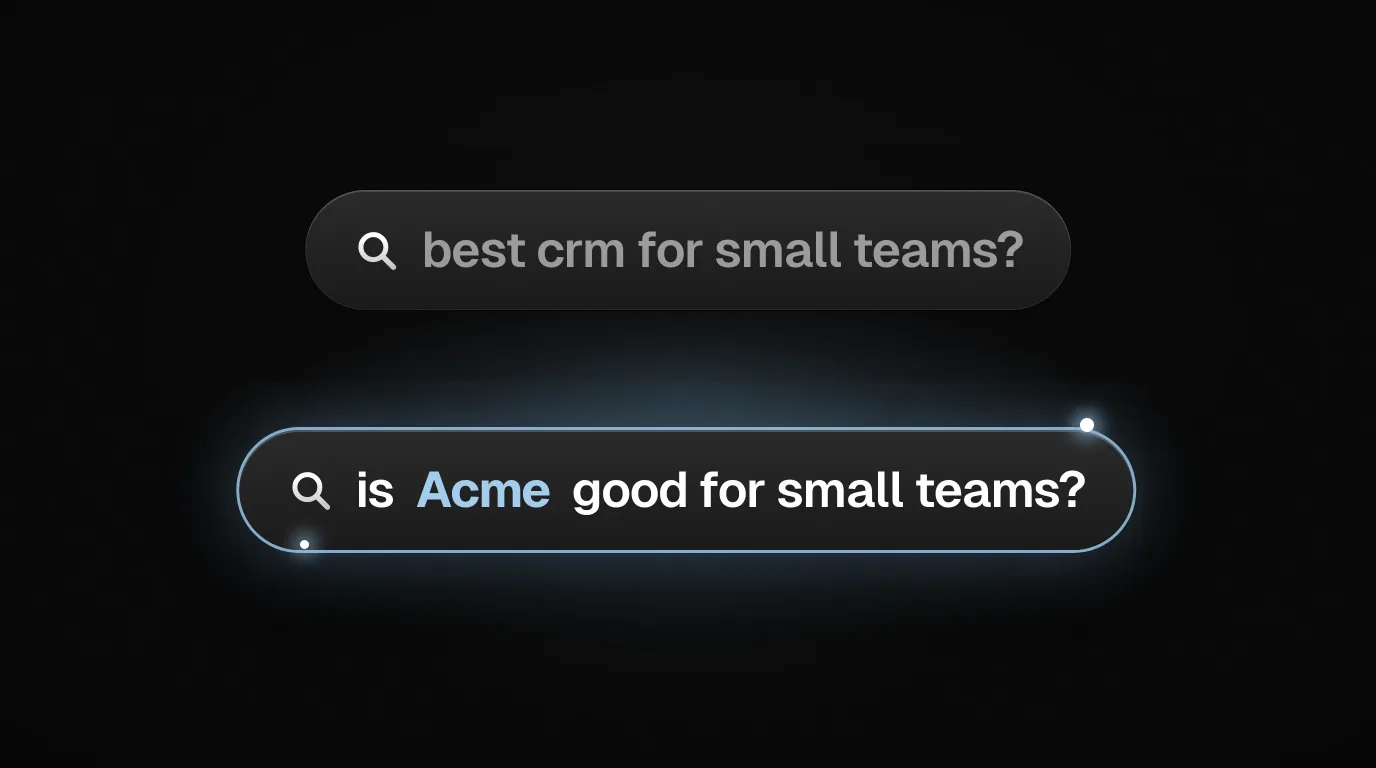
- Write the questions a buyer would ask. Mix category questions ("best CRM for a 10-person sales team"), comparisons ("Northwind vs Oakline", two made-up brands) and problems ("how do we stop losing leads after a demo"). Include questions with and without your brand name, and report the two groups separately (why).
- Pick the AI tools your buyers use. For example ChatGPT, Google AI Overviews and AI Mode, Perplexity, Gemini and Microsoft Copilot. Start each question in a fresh chat where the tool supports it, and record the tool, the date, and the country and language you used.
- Ask each question and save the whole answer, with any source links, so you can verify the count later.
- Log one row per question and tool: the date, the engine, the question, whether it named you, whether it cited your site (and which page), the brands it named, and a note. If Google shows no AI Overview, log that as a result rather than a miss, and report how often an Overview appeared as well as how often you did.
- Count, and keep the denominator. Write "named in 9 of 20 answers", not "45%" on its own. Count each engine separately, and count your closest rivals the same way.
- Ask the same questions again a week or so later, with the same wording, and compare.
Here is the log with an invented example. Acme is a made-up CRM. Every row and figure below is invented to show the format, and nothing here is measured.
| Date | Engine | Question | Named Acme? | Cited Acme's site? | Brands named | Note |
|---|---|---|---|---|---|---|
| Day 1 | ChatGPT | What's the best CRM for a 10-person B2B sales team? | Yes | No | Northwind, Acme, Oakline | |
| Day 1 | Google AI Overview | What's the best CRM for a 10-person B2B sales team? | No | No | Northwind, Oakline | |
| Day 1 | ChatGPT | Northwind vs Oakline: which fits a small team? | No | No | Northwind, Oakline | Question names no Acme |
| Day 1 | Google AI Overview | How do we stop losing leads after a demo? | Yes | Yes | Acme, Brightdesk | Cited Acme's how-to page |
These four rows show the format. Assume the full log has 20 rows (10 questions, each asked on ChatGPT and on Google AI Overview), that Google showed an overview every time, and that the 20 checks add up to these totals:
| Brand | Answers naming it, of 20 | Mention rate | Share of voice |
|---|---|---|---|
| Acme | 9 | 45% | 25.7% |
| Northwind | 14 | 70% | 40.0% |
| Oakline | 8 | 40% | 22.9% |
| Brightdesk | 4 | 20% | 11.4% |
| Total tracked brand mentions | 35 | 100% |
Acme's site was cited in 4 of the 20 answers, and 3 of those 4 also named Acme. So in 10 answers Acme was neither named nor cited, in 6 it was named only, in 3 both, and in 1 cited only. Acme is named in 45% of the answers and holds 25.7% of the naming, and Northwind is named more often than any other tracked brand.
Why do you need to ask the same question more than once?
AI answers can vary between runs, so one check is a sample, not a verdict. In a study published on 28 January 2026, 600 volunteers ran 12 prompts across ChatGPT, Claude and Google Search's AI features, 2,961 runs in all. For the prompts tested, the authors estimated a chance of less than 1 in 100 that two responses from ChatGPT or Google's AI would give the same list of brands. They suggested measuring how often each brand appeared across repeated runs of the same prompt, which they judged probably a reasonable measure. SparkToro disclosed that its research partner works at Gumshoe.ai, an AI-tracking startup (SparkToro).
Whether Google shows an AI Overview at all also varies. From our own test, in Why Google AI Overviews sometimes show nothing:
We asked 50 prompts twice each, and in 23 of the 50 pairs the two answers did not match. In 21 of those 23, one ask got a Google AI Overview and the other got nothing.
So repeat the same questions and record each run separately.
How do you read the results?
Compare results from the same questions, tools and counting rules.
- Read each engine on its own. If engines have different mention rates, changing how many checks you run on each can move the combined rate.
- Split the questions that name you from the ones that do not. Questions without your brand name show how often the sampled answers bring it up unprompted.
- Do not turn it into one score. Semrush compares brand mentions with the median for its top industry competitors (Semrush help, read 26 November 2026). Ahrefs reports mentions, citations, AI share of voice and estimated impressions separately, and its share of voice uses the responses in a topic set that mention or cite a brand, against competitors (Ahrefs Brand Radar, read 26 November 2026). Two tools can give one brand different numbers without either being wrong.
- Treat the order of names in one answer as one observation. In SparkToro's test, the order of brands changed almost every run. Count how often each brand appears instead.
- Remember what a citation is. It shows where an answer points. It does not show that the page says what the answer says. Where does AI get its information? shows how to open a citation and check it.
How do you improve your AI visibility?
No one can promise a result, but your check shows where to look first. Open an answer that names a rival and leaves you out. Read the pages it cites, and check whether your own site answers that buyer question clearly and accurately.
For Google's AI features, Google says no special optimization is necessary. To be eligible as a supporting link in AI Overviews or AI Mode, a page must be indexed and eligible to be shown in Search with a snippet, and Google does not guarantee that it will be shown (Google Search Central, updated 10 December 2025). Google's newer guide adds that the site must be included in its generative AI features in Search Console, which is the default (Google Search Central). For what published research does and does not show about getting cited, see How to get cited by ChatGPT. For how this work relates to SEO, GEO and AEO, see GEO vs AEO vs SEO in plain English.
What does a tool add to a manual check?
A manual check shows you what to look for. To repeat it, you copy and log every answer again: 20 questions on three tools is 60 answers each time. A tool asks the questions on a schedule, keeps every answer, and shows how the counts move over time and against your rivals. Citestreak is one such tool, and it is in private beta (what it does, and a sample report on a made-up brand). To compare tools, see How to choose an AI visibility tool.
What is a good AI visibility score?
There is no benchmark we can stand behind. A good number depends on your category, your questions, the tools you check and the day. Compare your results with your earlier checks and with your closest rivals on the same questions, and say how many checks each count covers.
The glossary defines these terms, and Accuracy and limits lists what a count of AI answers can and cannot tell you.